AI Policy Template: AI Acceptable Use Policy (Word)
A ready-written document you adapt to your business. Instant download.
Your team is already using AI. This AI policy template decides how.
Used properly, this is what it does for your business:
- ✓More customers: clients trust you with their information when you can show them your rules.
- ✓More profit: your team works faster with AI, without the cost of a data leak or a public correction.
- ✓Less stress: everyone knows what is allowed, so you are not left wondering what has been pasted where.
- ✓Look the part: a signed, written AI policy to show any client, insurer or auditor who asks how you use AI.
Why not a free AI policy template? Many are a page of principles that nobody can act on. This one is a working staff rulebook, with a traffic-light table, a never-list, a checking table, a sign-off sheet and a worked example, written by a former company director of over 30 years who runs three businesses and uses AI tools in all of them every day.
"Plain Standards have continually under-promised and over-delivered. Outstanding service." Paul J, ATM Security
Someone pastes a customer's details into a free chatbot to tidy up a letter. Someone else sends a proposal with a statistic the AI made up. Nobody meant any harm, and nobody had told them where the lines are. One leaked customer record or one invented claim can cost you a client, and your reputation with it.
I run three businesses and use AI tools in all of them every day. In over 30 years running companies at director level, I learned that new tools don't cause the trouble; using them without rules does. This template is the short rulebook I would give any team: which tools are approved, what never goes into them, how every answer is checked before it is used, and who to tell when something goes wrong.
Who this is for
Any business whose people use AI tools at work, or soon will: an office, an agency, an accounting firm, a shop, a care provider, a trade business or a consultancy. It suits a business with no IT department or lawyer on the payroll, and you don't need to know anything about AI to use it.
It is a starting point, not legal advice. AI law is changing fast, especially in the European Union, and the rules differ between countries, states and industries. If you work in a heavily regulated field, such as healthcare, finance or law, check it with an adviser who knows your sector's rules.
See an example
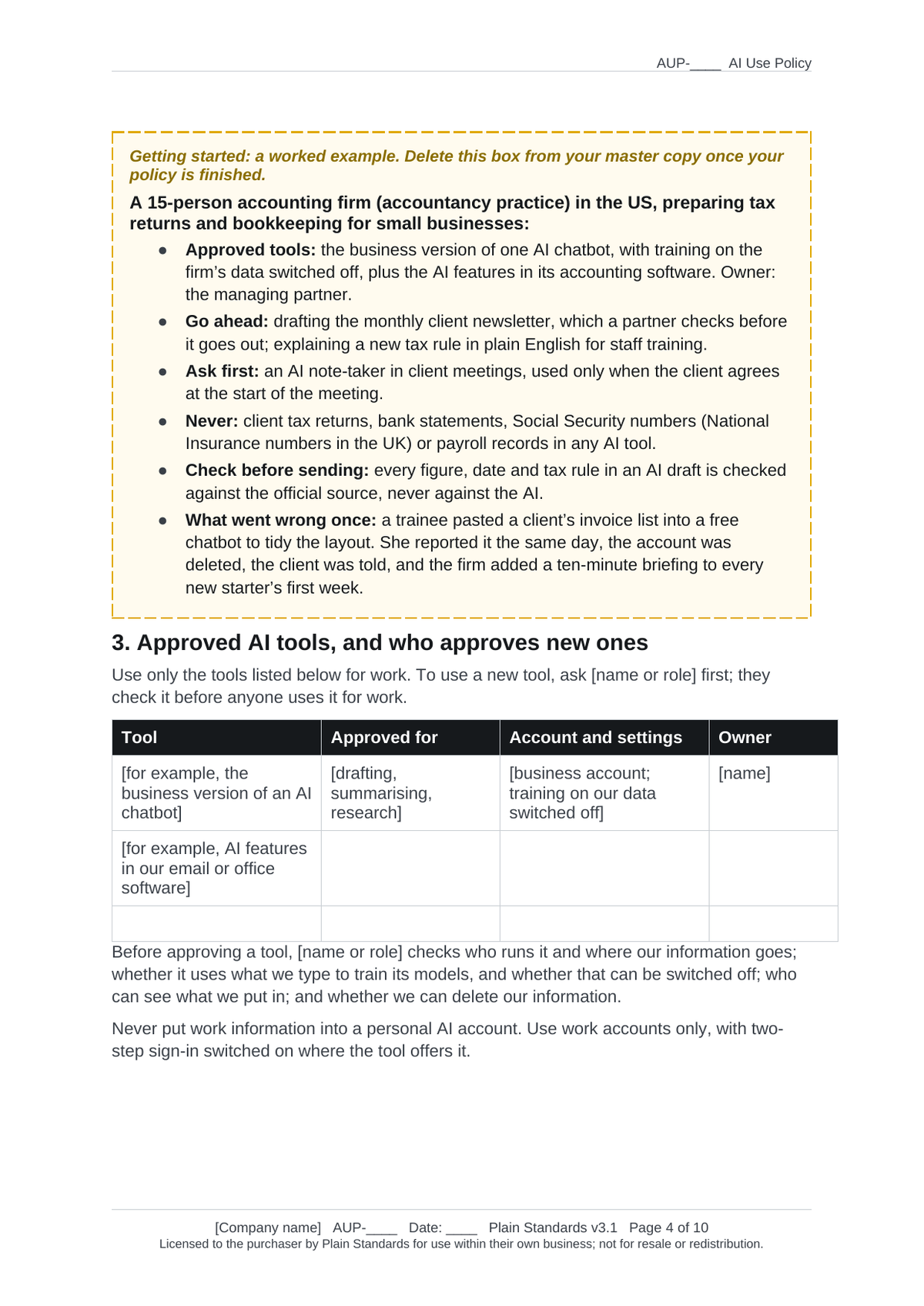
The worked example inside the template follows a 15-person accounting firm (accountancy practice) in the US. Here is its policy in brief:
- Approved tools: the business version of one AI chatbot, with training on the firm's data switched off, plus the AI features in its accounting software.
- Go ahead: drafting the monthly client newsletter, which a partner checks before it goes out.
- Ask first: an AI note-taker in client meetings, used only when the client agrees.
- Never: client tax returns, bank statements, Social Security numbers (National Insurance numbers in the UK) or payroll records in any AI tool.
- Check before sending: every figure, date and tax rule checked against the official source, never against the AI.
- What went wrong once: a trainee pasted a client's invoice list into a free chatbot. She reported it the same day, the client was told, and every new starter now gets a ten-minute briefing in their first week.
The template walks you through the same decisions for your own business, section by section.

This is a ready-made AI acceptable use policy in Microsoft Word: a practical rulebook of a few pages that your staff read and sign, like a section of a staff handbook.
It is laid out in the order your team needs it: who it covers; that each person is responsible for their own work, with or without AI; your approved AI tools and who approves new ones; a traffic-light table of what staff can use AI for (go ahead, ask first, never); what must never go into an AI tool; how to check AI output before it is used or sent; claims, reviews and being open with customers; copyright; decisions about people; training; reporting AI mistakes; what happens if the rules are broken; and how often the policy is reviewed.
It also comes with a removable Start here page, a short note from me on how I use AI safely, a worked example you can copy, a table showing where it fits with ISO 9001, plain explanations of the AI words staff will hear, and a staff acknowledgement sheet to sign.
Clear lines your team can follow
A traffic-light table shows at a glance what staff can do with AI, what needs a manager's say-so first, and what is never allowed. No jargon, no guesswork, no “I didn't know”.
Customer data stays out of AI tools
A plain list of what must never be typed, pasted or uploaded: customers' personal details, staff records, confidential prices and plans, passwords, and anything shared with you in confidence. Many AI tools keep what you type, so this is the rule that protects you most.
Every AI answer checked before it goes out
AI tools can invent facts, figures, quotes and sources, and sound completely sure of themselves. A short checking table makes sure a person confirms every claim against the original source before anything reaches a customer, and looks again once it is live.
No invented reviews, results or credentials
The policy rules out AI-written reviews and testimonials, which are banned by the Federal Trade Commission in the US and by the Digital Markets, Competition and Consumers Act 2024 in the UK, and makes sure a person always makes the final call on decisions about people.
Staff who know the rules, and sign to say so
A training section, a way to report AI mistakes without fear, a fair process if the rules are broken, and a staff acknowledgement sheet. You can show anyone who asks that your team has read and agreed the rules.
Ready if you work to ISO 9001
ISO 9001:2026 does not ask for an AI policy by name, but this policy supports several of its requirements, including protecting your information (clause 7.5.3) and your customers' personal data (clause 8.5.3), and making only claims you can deliver (clause 8.2.2). A table inside shows where it fits. You don't need any of that to get value from it today.
Where this leads
- AI usage policy: the free Learn page on what to include, with two examples.
- Employee Onboarding Checklist: make the AI policy part of every new starter's first week.
- Risk Register Template: list what could go wrong with AI and your other risks, and decide what to do about them.
Why buy from us
- ✓Built by a company director, not an auditor. Written by someone who ran real businesses before building management systems, so what you get works in the real world, not just on paper.
- ✓Written in plain English. No jargon, no clause-speak. If you are new to ISO 9001, it will make sense on day one.
- ✓The Operator's Take, in every document. Look inside any Plain Standards document and you will find a boxed note called The Operator's Take: a short, plain comment from someone who has run businesses, explaining why this document actually matters to yours, and how to get real value from it, not just tick a box for an auditor. No other provider gives you this, because it comes from having sat in the chair.
What is an AI policy template?
An AI policy template is a ready-made set of workplace rules for using artificial intelligence tools: which tools are approved, what must never go into them, how their output is checked and who is responsible. Instead of starting from a blank page, you fill in your own tools, names and examples.
What is an AI acceptable use policy?
It is the part of your rules that tells staff what they may and may not do with AI tools at work, in the same way an internet or email use policy does. This template is an AI acceptable use policy, with a sheet for staff to sign.
Does it cover generative AI tools such as chatbots?
Yes. It covers any tool that writes, summarises, translates, answers questions, takes meeting notes or creates images, audio or video, including AI features built into software you already use.
Does it work for UK businesses?
Yes. It is written for US and UK businesses, with the US rules first and the UK equivalents alongside, for example on fake reviews and reporting a data breach. It is a starting point, not legal advice, so check it against the rules where you operate.
Will it make my business legally compliant with AI law?
No template can promise that. AI law is changing fast, especially in the European Union, and the rules differ by country, state and industry. This policy sets out good practice and a clear process; check it with a lawyer or adviser who knows your rules before you rely on it.
Is it based on the NIST AI framework?
It draws on the US National Institute of Standards and Technology's guidance on generative AI risks, such as made-up answers and data leaks, and on UK guidance from the National Cyber Security Centre and the Information Commissioner's Office. It is a practical staff policy, not a full NIST risk management framework.
Is it suitable for a small company?
Yes. It is written for small and medium sized businesses, from a sole trader with one assistant to a company of a few hundred people, and runs to a few pages your staff will actually read.
Can a nonprofit, law firm or healthcare business use it?
Yes, as a starting point. Regulated fields often have extra rules on client confidentiality and patient data, so add your sector's requirements and check the finished policy with an adviser.
Is this AI policy template in Word?
Yes, it is a Microsoft Word file (.docx) that you download straight away and edit like any other Word document. It also opens in Google Docs and other word processors that read .docx files, though a few layout details may shift slightly outside Word.
Written by Mike Armstrong, senior ISO consultant, former company director, and founder of Plain Standards. In over 30 years running companies at director level, Mike built his own management systems to drive profit long before he adopted ISO 9001, so he comes at this from the owner's side, not the auditor's. Plain Standards helps small and medium sized businesses get ISO certified without a consultant.
- 5 stars: 2 (100%)
- 4 stars: 0 (0%)
- 3 stars: 0 (0%)
- 2 stars: 0 (0%)
- 1 star: 0 (0%)
Excellent customer setvice
Clear policy on the use of AI. Very easy to follow and understand