ISO 14001:2026 Aspects and Impacts Register Template
A ready-written document you adapt to your business. Works on its own. Instant download.
Know which of your environmental effects really matter, score every one the same way, and show your working when a customer or an auditor asks.
Used properly, this is what it does for your business:
- ✓More customers: show a buyer or a tender panel exactly how you manage your effect on the environment.
- ✓More profit: put your effort into the few things that matter, and find the waste, energy and fuel you are paying for.
- ✓Less stress: one clear rule for every line, so no arguing about what counts.
- ✓Look the part: a register an auditor can follow from the aspect to the action to the proof.
Why not a free aspects and impacts register? Many are a blank grid that leaves the scoring to you. This one has the scoring table and the rule built in, sixteen worked lines to copy, the life cycle stages the 2026 edition spells out, and columns that carry each line through to proof. It was written by a company director of over 30 years who has written and managed ISO 14001 systems for several companies.
"Plain Standards have continually under-promised and over-delivered. Outstanding service." Paul J, ATM Security
ISO 14001 requires you to list how your business touches the environment, decide which of those effects are significant, and write down the rule you used to decide. It is the heart of the standard, and the part owners tend to find hardest. A blank grid doesn't help much: the hard part is knowing how much detail is enough and where to draw the line.
I've written and managed ISO 14001 systems for several companies. My own registers scored each effect from 1 to 4 for how serious it was and 1 to 4 for how likely, and multiplied the two. This register keeps that simple method and adds what I'd want a new owner to have beside it: the rule in plain words, and a full worked example to copy.
Who this is for
Any business building an environmental management system to ISO 14001, or asked by a customer how it manages its effect on the environment. You don't need an environmental specialist to use it.
Two cases where you don't need it:
- If you are buying The ISO 14001:2026 Environmental Management System, the register is already in it, with its procedure. Don't buy it twice.
- If no customer is asking and you are not working towards ISO 14001, a simple list of your main wastes and energy use may be all you need.
It is a register to fill in. It does not come with your aspects already listed, because they depend on what your business does and where.
See an example
The worked example inside follows a small joinery firm. Here are four of its sixteen lines, in brief:
- Spraying lacquer and stains. Aspect: solvent fumes and overspray. Impact: air pollution, dust and smell for the neighbours. Scored 3 for how serious and 4 for how likely: 12, so significant. Action: water-based finishes wherever the job allows, and booth filters changed monthly.
- Storing finishes and fuel. Aspect: a possible spill. Impact: pollution of the drains and the stream. Scored 4 for how serious and 1 for how likely: only 4, but significant anyway, because the harm would be major. Action: a bunded store, a spill kit by the yard drain and a drill twice a year.
- Buying timber. Aspect: where the timber comes from. The firm cannot control this, only influence it, so the action is to buy certified timber and check the claim on every delivery note.
- Washroom and tea point. Aspect: water use. Scored 1 and 4: 4, not significant. Action: fix drips promptly.
The same rule is applied to every line, and the register shows why each one made the cut or didn't.

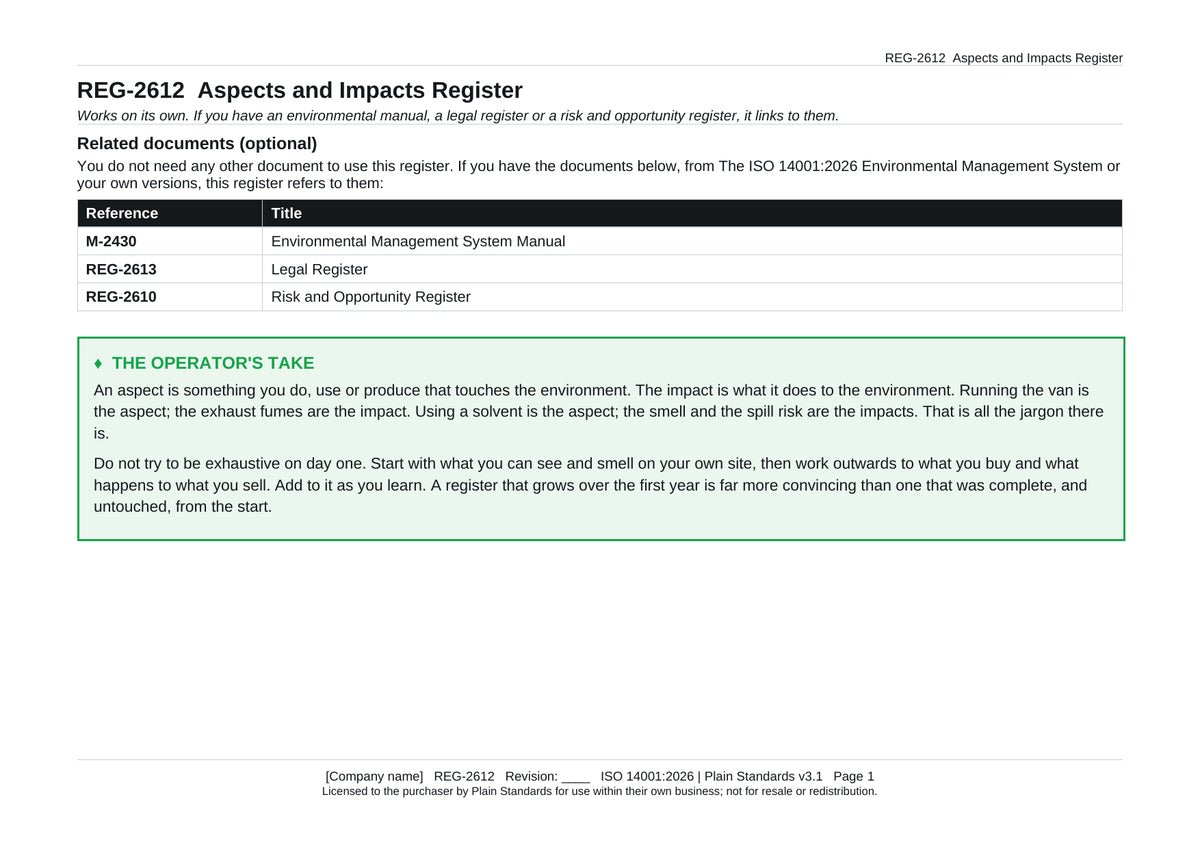
This is a ready-made aspects and impacts register in Microsoft Word, written to ISO 14001:2026. An aspect is something you do, use or produce that touches the environment. The impact is what it does. Running the van is the aspect; the exhaust fumes are the impact.
It works on its own. You do not need any other document to use it. Inside the 13 pages you get:
- How to fill it in: five plain definitions, five steps for finding your aspects, and what to do about the ones that matter.
- The scoring table and the rule: a 1 to 4 scale for how serious and how likely, and one rule for what counts as significant. These are the written criteria ISO 14001 requires you to keep.
- A full worked example: sixteen filled-in lines for a small joinery firm that makes doors and windows and fits them on site, from buying timber to what happens to a window at the end of its life. Eight are marked significant, each with its reason.
- The blank register: fourteen columns, from the activity and its life cycle stage through to who owns the action and whether it worked.
- A key to every column, set out one line at a time.
$49, paid once, covers your whole business: every site, every review, for as long as you use it. Corrections and improvements are free for the life of this edition.
A worked example, not a blank grid
Sixteen real lines show you how much detail is enough, how to word an aspect and its impact, and what a sensible action looks like. Each line carries through to the end: what the firm does about it, how it will check, and what it found when it checked. You read it, then write your own.
The rule for "significant", written down
ISO 14001 requires you to decide which aspects are significant using criteria you set, and to keep those criteria written down. The EPA puts it the same way: an organisation "will need to establish criteria to determine which of its aspects are significant". The scoring table and the rule are inside the register, so the criteria and the results sit together, and anyone repeating the scoring would reach the same list.
It looks beyond your own gate
The 2026 edition spells out the life cycle stages to think about, from raw materials and design through to use and final disposal. Every line of the register names its stage, and the example runs from designing a door to what happens to it at the end of its life.
Normal days, bad days and emergencies
A separate column records whether each line is about normal running, abnormal conditions such as start-up, maintenance or a breakdown, or an emergency such as a fire or a spill. Another records whether you control the aspect or can only influence it. Both are things ISO 14001 requires you to take into account, and both are easy to forget.
From a list to action
A list on its own changes nothing. For every line the register records what you do about it, who owns it, how you will check it worked, and what you found. That is what turns a register into evidence.
Where this leads
- What is ISO 14001: the standard in plain English, and where this register fits in it.
- Legal Register Template: list the environmental laws that apply to you, the column your aspects register points to.
- ISO 14001:2026 Audit Checklist Template: find the gaps in your environmental system yourself, while they are small and easy to fix.
Part of a complete system
- This register, $49. The aspects and impacts register on its own, with its instructions and scoring table built in.
- The ISO 14001:2026 Environmental Management System, $997. All 40 documents, including the aspects and impacts register, its procedure, the legal register and the manual, built to work together.
- Need quality or health and safety too? The Integrated Management System covers ISO 9001 with ISO 14001, ISO 45001 or both, written as one system.
Why buy from us
- ✓Built by a company director, not an auditor. Written by someone who built management systems while running real businesses, so what you get works in the real world, not just on paper.
- ✓Written in plain English. No jargon, no clause-speak. If you are new to ISO 14001, it will make sense on day one.
- ✓The Operator's Take, in every document. Look inside any Plain Standards document and you will find a boxed note called The Operator's Take: a short, plain comment from someone who has run businesses, explaining why this document actually matters to yours, and how to get real value from it, not just tick a box for an auditor.
Frequently asked questions
What are environmental aspects and impacts?
An environmental aspect is something your business does, uses or produces that can affect the environment, such as burning fuel, using water or producing waste. The impact is the change that results, such as air pollution or less waste going to landfill. Running a van is an aspect; its exhaust fumes are the impact.
What is an aspects and impacts register?
It is the list of your environmental aspects and their impacts, showing which ones are significant and what you do about them. It is the working record at the centre of an ISO 14001 environmental management system.
Does ISO 14001 require an aspects and impacts register?
ISO 14001 requires you to keep three things as documented information: your aspects and their impacts, the criteria you used to decide which are significant, and the significant aspects themselves. It does not insist on the word "register", but a register is the usual way to hold all three.
How do you decide which aspects are significant?
You set your own criteria and apply them the same way to every aspect. This register scores each impact from 1 to 4 for how serious it would be and 1 to 4 for how likely it is, and multiplies the two. A score of 8 or more is significant, and so is anything scored 4 for how serious, whatever its total.
Is it an Excel file?
No, it is a Microsoft Word file (.docx), set out in landscape. The scoring is a simple multiplication you can do in your head. It also opens in Google Docs and other word processors that read .docx files.
Do I need a procedure as well?
Not to use this register: the steps, the scoring table and the rule are inside it. If you want the full procedure, with the rest of the system it belongs to, it is in The ISO 14001:2026 Environmental Management System.
Is it written to the 2026 edition?
Yes. It is written to ISO 14001:2026, the edition published in April 2026, including the life cycle stages that edition spells out.
Will it work for an office or a service business?
Yes. The method is the same for any business. Your list will be shorter than a workshop's: energy, travel, paper, waste and what you buy. The worked example includes office and washroom lines to show how small ones are handled.
Written by Mike Armstrong, senior ISO consultant, former company director, and founder of Plain Standards. In over 30 years running companies at director level, Mike built his own management systems to drive profit long before he adopted ISO 9001, so he comes at this from the owner's side, not the auditor's. Plain Standards helps small and medium sized businesses get ISO certified.