Skip to product information
1 of 4

ISO 14001:2026 Audit Checklist Template

$49

A ready-written document you adapt to your business. Works on its own. Instant download.

Find the gaps in your environmental system yourself, while they are small and easy to fix, and have the record ready when a customer or an auditor asks.

Used properly, this is what it does for your business:

  • ✓More customers: show a buyer or a tender panel that you check your own environmental system, with the records to prove it.
  • ✓More profit: find wasted energy, materials and effort, and fix problems while they are still small.
  • ✓Less stress: know where you stand before an outside auditor, a customer or a regulator looks.
  • ✓Look the part: clear audit records, graded and signed off, the way a professional auditor expects to see them.

Why not a free ISO 14001 checklist? Many free ones repeat the standard's wording as yes or no questions, or were written for the 2015 edition. This one is written to ISO 14001:2026, asks 77 questions in plain English that send you to look at the work, and has the six audit steps, the grades and a worked example built in. It was written by a company director of over 30 years who has written and managed ISO 14001 systems for several companies.

Director-built, not auditor-built
Plain English, no jargon
Instant download, yours to keep

"Plain Standards have continually under-promised and over-delivered. Outstanding service." Paul J, ATM Security

ISO 14001 requires you to audit your own system at planned times. The hard part is knowing what to ask. Many checklists hand the standard back to you as a list of yes or no questions, in the standard's own language, which tells you very little about what is really happening in the yard or the workshop.

I've written and managed ISO 14001 systems for several companies, and trained as an internal auditor for the standard. The audits that found something useful were never the ones done from a desk. So every question in this checklist sends you to look at something, ask someone or pick a real example, and gives you a place to write down what you saw.

Who this is for

Any business running an environmental management system to ISO 14001, or building one, that has an internal audit to do. It suits an owner or manager auditing for the first time as well as someone who has audited before and wants better questions.

Two cases where you don't need it:

  • If you are buying The ISO 14001:2026 Environmental Management System, this checklist is already in it, with the audit procedure and the audit programme. Don't buy it twice.
  • If you have no environmental system yet, start with the system. A checklist checks a system; it does not build one.

It is a checklist for auditing your own business. It does not make anyone a trained auditor, and it does not replace the audit a certification body carries out.

See an example

The worked example inside shows part of a small joinery firm's July audit of its planning, carried out by the site supervisor. Three of its lines, in brief:

  • Have the environmental aspects and impacts been found, thinking about the whole life cycle? Yes. Evidence: the firm's aspects and impacts register, reviewed in March.
  • Are significant aspects communicated to the people concerned? No, graded a minor nonconformity. Evidence: two labourers who started in June had not been told about the sawdust and lacquer aspects, because their inductions were never finished. A corrective action was raised.
  • Are the planned actions being carried out at the times set? Yes, with an opportunity for improvement. The electricity action was on track, but recycling was stuck at 40 per cent, so the auditor suggested asking a board recycler to take the sheet-material offcuts.

The result: one minor nonconformity, one idea, reported to the owner the next day. That is what a useful audit looks like: a short record of what was seen, and something fixed because of it.

This is a ready-made internal audit checklist in Microsoft Word, written to ISO 14001:2026. An internal audit is you checking your own system before anyone else does: does it meet the standard, does it follow your own rules, and is it actually being used?

It works on its own. You do not need any other document to use it. Inside the 15 pages you get:

  • How to run an audit, in six steps: plan the year, choose the auditor, set up each audit, go and look, grade and agree, act and report.
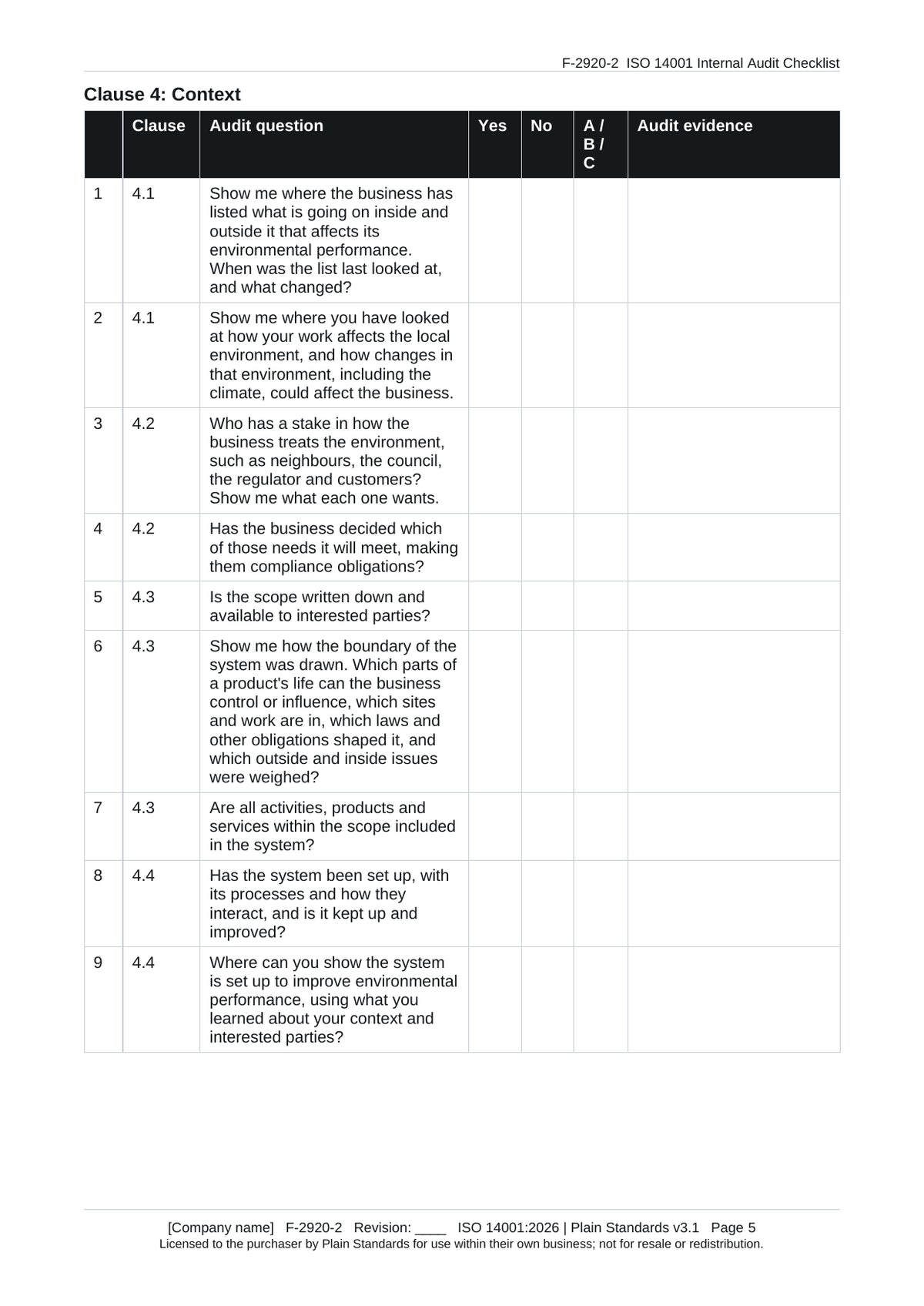
  • 77 audit questions in plain English, covering every requirement clause of ISO 14001:2026, from clause 4 to clause 10, each with its clause number beside it.
  • A tick grid of the 22 clauses, so you audit a few at a time and can show the whole standard was covered over the year.
  • Four plain grades: met, could be better, minor nonconformity, major nonconformity, each explained in a sentence.
  • A worked example: part of a small joinery firm's July audit, with one problem found, one idea for improvement, and how each was recorded.
  • A summary and sign-off, so every completed checklist is a finished audit record.

$49, paid once, covers your whole business: every site, every audit, for as long as you use it. Corrections and improvements are free for the life of this edition.

Questions that send you to look

"Is there a process for emergency preparedness?" can be answered from a chair. This checklist asks you to walk to where the chemicals or fuel are kept, find the spill kit and the written plan, and judge whether someone could follow it under pressure. Then it asks a worker what they would do if a drum leaked. The EPA describes an internal audit the same way: an "objective and impartial party" carrying out interviews and walkthroughs.

Every requirement clause, in bite-sized pieces

The 77 questions follow ISO 14001:2026 from clause 4 to clause 10, with the clause number beside each one. You are not expected to ask them all at once. Tick the clauses for this audit, work through those, and over the year the grid shows the whole standard was covered. The EPA suggests the same for a new system: smaller, more frequent audits, not the whole system in one go.

The steps are inside, so it works on its own

Six steps on the first page cover what a full audit procedure would tell you: how to plan the year, who can audit what, how to set up each audit, how to grade what you find, and what to do afterwards. ISO 14001 requires a written audit programme, and auditors chosen so the audit is objective and impartial. The steps show you how to meet both in a small business, including a business of one.

Clear grades, so findings get fixed

Each question has a yes, a no, a grade and a space for the evidence. The four grades are explained in plain words, so two people grading the same finding would tend to reach the same answer, and you know which findings need a corrective action and which only deserve thought.

A record you can hand over

The summary and sign-off turn each completed checklist into an audit record: what was audited, by whom, what was found, what was raised and who it was reported to. ISO 14001 requires you to keep evidence that the audits were carried out and of their results.

Where this leads

Part of a complete system

  • This checklist, $49. The ISO 14001 internal audit checklist on its own, with the six audit steps built in.
  • The ISO 14001:2026 Environmental Management System, $997. All 40 documents, including this checklist, the internal audit procedure, the audit programme and the manual, built to work together.
  • Need quality or health and safety too? The Integrated Management System covers ISO 9001 with ISO 14001, ISO 45001 or both, written as one system.

Why buy from us

  • ✓Built by a company director, not an auditor. Written by someone who built management systems while running real businesses, so what you get works in the real world, not just on paper.
  • ✓Written in plain English. No jargon, no clause-speak. If you are new to ISO 14001, it will make sense on day one.
  • ✓The Operator's Take, in every document. Look inside any Plain Standards document and you will find a boxed note called The Operator's Take: a short, plain comment from someone who has run businesses, explaining why this document actually matters to yours, and how to get real value from it, not just tick a box for an auditor.

Frequently asked questions

What is an ISO 14001 audit checklist?

It is a list of questions an auditor works through to check an environmental management system against ISO 14001, with a place to record the evidence for each answer. This one is for internal audits: the checks a business carries out on its own system.

Does ISO 14001 require internal audits?

Yes. ISO 14001 requires internal audits at planned intervals, to check that the system meets the standard and the business's own requirements, and that it is being used and kept up. It also requires an audit programme and records of the results.

Is it an Excel file?

No, it is a Microsoft Word file (.docx). You print it and fill it in by hand, or type into it on screen. It also opens in Google Docs and other word processors that read .docx files.

Can I have it as a PDF?

It comes as a Word file so you can add your company name and edit it. To make a PDF, use Save as PDF in Word.

Who can carry out the audit?

ISO 14001 does not name a course or a qualification. It requires auditors to be chosen so that the audit is objective and impartial, which in practice means nobody audits their own work so far as the size of the business allows. The six steps in the checklist show how a small business, or a business of one, can manage that.

Do I need an audit procedure as well?

Not to use this checklist: the six steps inside it cover how to plan, carry out and report an audit. If you want the full written procedure and the audit programme form, with the rest of the system they belong to, they are in The ISO 14001:2026 Environmental Management System.

Do I have to ask all 77 questions at every audit?

No. Tick the clauses you are auditing this time and ask only those questions. Over the year, the tick grid shows that every clause has been covered.

Is it written to the 2026 edition?

Yes. It is written to ISO 14001:2026, the edition published in April 2026, and the clause numbers beside the questions are that edition's.

Will it work for an office or a service business?

Yes. The questions are the same for any business. In an office or service business the things you look at are usually energy, paper, travel, waste and the effects of the services you sell, and the checklist says so.

Written by Mike Armstrong, senior ISO consultant, former company director, and founder of Plain Standards. In over 30 years running companies at director level, Mike built his own management systems to drive profit long before he adopted ISO 9001, so he comes at this from the owner's side, not the auditor's. Plain Standards helps small and medium sized businesses get ISO certified.