Job Safety Analysis Template (Word)
A ready-written document you adapt to your business. Instant download.
Plan every risky job step by step, before one wrong move costs you a worker, a claim or a contract.
Used properly, this is what it does for your business:
- ✓More customers: hand clients and main contractors a signed JSA when they ask for one before work starts.
- ✓More profit: fewer injuries, fewer days lost and fewer costly claims and stoppages.
- ✓Less stress: peace of mind that every crew knows the safe way to do the job before it starts.
- ✓Look the part: a written, signed record for any inspector, insurer or client who asks how the job was planned.
Why not a free JSA template? Many give you a blank three-column grid and leave the rest to you. This one adds what OSHA in the US, the HSE in the UK and ISO 45001 each recommend: which jobs to start with, controls chosen strongest first, a hazard prompt list, a before-work checklist, a changes log, crew sign-on and a worked example. It was written by a company director of over 30 years who has checked job safety analyses on offshore installations and onshore oil and gas facilities.
"Plain Standards have continually under-promised and over-delivered. Outstanding service." Paul J, ATM Security

Changing a machine blade, working on a roof, lifting a heavy load, cutting into a pipe. Jobs like these tend to go wrong at one particular step, and the cost lands on the business: an injured worker, days lost, a claim against you, or a client who stops sending work. Clients and main contractors can also ask to see a job safety analysis before they let your crew start. In the US, OSHA recommends job hazard analysis and requires a written certification of your hazard assessment wherever workers need protective equipment. In the UK, every employer must assess the risks of their work, and if you employ five or more people, the law requires you to write down the significant findings.
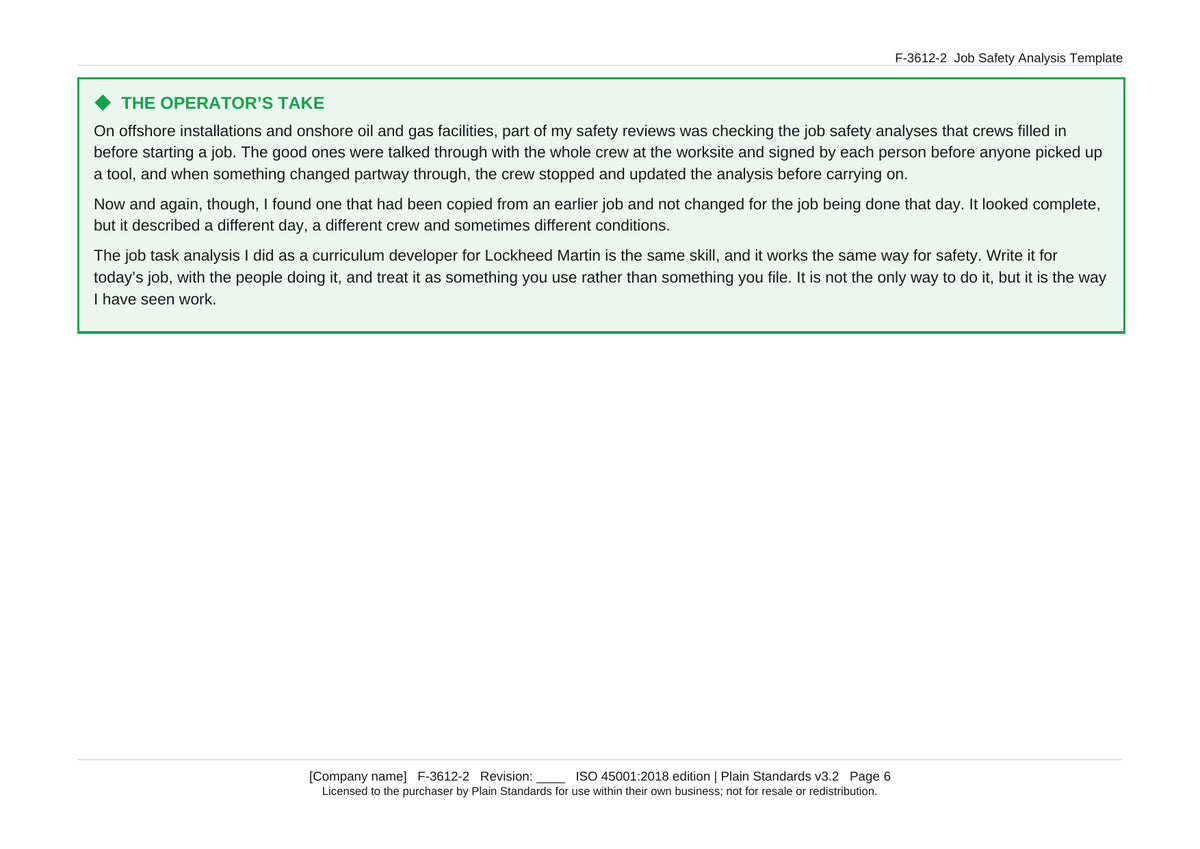
On offshore installations and onshore oil and gas facilities, part of my safety reviews was checking the job safety analyses crews filled in before starting work. The ones that worked were written for that day's job, talked through with the whole crew at the worksite, signed by everyone and updated the moment anything changed. This template is built to work that way.
Who this is for
Any business whose people do jobs with real hazards, and any supervisor who has to brief a crew before work starts. You don't need a health and safety specialist or any experience of job safety analysis to use it.
A JSA covers one job. For a whole area or activity, use a general risk assessment as well; some hazards, such as asbestos or hazardous chemicals, have their own detailed rules and assessments. Use this template alongside those, not instead of them.
See an example
The worked example inside the template follows a small joinery firm in England changing the blade on its panel saw, after an offcut was thrown back by the saw in March. Here it is in brief:
- Step 1, isolate and lock off the saw: someone could switch it on with hands near the blade. Control: switch off at the isolator, fit a personal padlock and tag (lockout/tagout in the US), then prove it will not start.
- Step 2, remove the guard and the old blade: cuts from the teeth. Controls: teeth facing away from the body, straight into the blade box, cut-resistant gloves.
- Step 3, fit the new blade: a blade that does not suit the saw can break up in use. Control: check its size and speed rating against the maker's manual first.
- Step 4, reset the riving knife: set too low, it lets an offcut be thrown back, as happened in March. Control: set it as the manual says and check the gap with the gauge, checked by a second machinist.
- Step 5, refit the guard and test run: a guard left off, or someone nearby. Controls: check the guard before the lock comes off, warn people nearby and stand clear.
- Change during the job: the new blade was thicker than the old one. The machinists stopped, checked the riving knife against the manual and noted it on the form.
The template walks you through the same analysis for any job, step by step.
It is built for any business where people do practical, hands-on jobs: builders and trades, electricians and plumbers, maintenance and facilities teams, factories and workshops, warehouses, oil, gas and energy, agriculture, landscaping and tree work, cleaning firms and event crews. The jobs differ from one trade to the next; the way you make them safe does not.
This is a ready-made job safety analysis (JSA) template in Microsoft Word, also known as a job hazard analysis (JHA) form in the US. You break one job into its steps, list what could go wrong at each step and who could be hurt, choose the controls strongest first, and record that the crew has been briefed and has signed.
It is laid out in the order you use it on site: the job, the place, the crew and any permits; the protective equipment needed; the job steps, hazards and controls table, with an optional Low, Medium or High rating; a before-work-starts checklist; a log for changes during the job; crew sign-on; an after-the-job review; and sign-off.
Before the blank form, short guidance pages explain which jobs to analyse first, how to do a JSA in eight steps, how to choose controls best first, the hazards to look for at each step, and what the law expects in the US and the UK. A worked example shows a full JSA you can copy. Use a fresh copy for each job: one $29 payment covers every job you analyse in your business, as often as you need.
The method OSHA recommends, in a form your crew will use
It follows the steps in OSHA's own guidance on job hazard analysis: choose the jobs most likely to hurt someone, involve the people who do them, watch the job and break it into steps, find the hazards at each step, and control them strongest first. In the UK, it gives you a practical way to assess a particular job, walking and talking through the task where it is done, as the Health and Safety Executive (HSE) advises. Wherever you are, check your own country's rules for anything extra you must record.
The strongest fix first
Controls are chosen in order: remove the hazard, swap it for something safer, guard it or keep people away from it, then rules, permits and training, and protective equipment last. That is the order OSHA uses in the US and ISO 45001 sets out, because the fixes at the top protect everyone without relying on people remembering.
Briefed, signed and ready before anyone picks up a tool
A before-work-starts checklist covers the crew briefing, isolations and permits, protective equipment and emergency arrangements. Then every member of the crew signs to say they understand the steps, the hazards and the controls.
Built for the day things change
Weather turns, a part arrives in the wrong size, someone new joins the crew. The changes log tells the crew to stop, make it safe and update the JSA before carrying on, with a record you can show afterwards.
Never start from a blank page
A one-page list of hazards to look for at each step, from falls and stored energy to human factors such as tiredness and rushing, prompts you to look in the places that are easy to miss.
Ready if you build a health and safety management system
ISO 45001, the international standard for health and safety management systems, requires a business to identify hazards in routine and non-routine work, take account of how the work is actually done, involve the people who do it, and choose controls in a set order (clauses 5.4, 6.1.2 and 8.1.2). This template covers each of those. You don't need ISO 45001 to get value from it today.
Where this leads
- Risk Assessment Template: find which jobs and areas carry the most risk in the first place.
- Method Statement Template: plan a whole job step by step, with the checks and sign-off your client or main contractor expects.
- Toolbox talks: brief the crew before the job, with a free record form and 52 topics.
- Business Templates: every ready-made template for running a business well.
Why buy from us
- ✓Built by a company director, not an auditor. Written by someone who ran real businesses before building management systems, so what you get works in the real world, not just on paper.
- ✓Written in plain English. No jargon, no clause-speak. If you are new to ISO 9001, it will make sense on day one.
- ✓The Operator's Take, in every document. Look inside any Plain Standards document and you will find a boxed note called The Operator's Take: a short, plain comment from someone who has run businesses, explaining why this document actually matters to yours, and how to get real value from it, not just tick a box for an auditor. No other provider gives you this, because it comes from having sat in the chair.
Is this JSA template in Word?
Yes, it is a Microsoft Word file (.docx) that you download straight away and edit like any other Word document. It also opens in Google Docs and other word processors that read .docx files, though a few layout details may shift slightly outside Word. Print it for the crew to sign on site, or fill it in on a laptop or tablet.
Is this an OSHA job hazard analysis template?
It follows the method in OSHA's guidance on job hazard analysis, and the US calls this kind of form a job hazard analysis (JHA). OSHA publishes its own free sample form. This template adds a hazard prompt list, controls chosen strongest first, a before-work checklist, a changes log, crew sign-on and a worked example, plus optional wording for the written hazard assessment certification OSHA requires where workers need protective equipment.
What is the difference between a JSA and a JHA?
In practice, very little. Job safety analysis and job hazard analysis are two names for the same thing: breaking a job into steps, finding the hazards at each step and deciding how to control them. OSHA uses job hazard analysis, and its own worksheet notes that it is sometimes called a job safety analysis.
Is there an Excel version?
No, it is a Word document. A JSA is mostly written steps, notes and signatures, which suit Word better than a spreadsheet, and it prints cleanly for signing on site. If you want to track many JSAs, list each one's reference, job and review date in a simple spreadsheet.
Is there a free job safety analysis template?
Yes, there are free ones online, including OSHA's sample job hazard analysis form. This one is ready to use without working out the rest yourself: guidance on which jobs to start with, a hazard prompt list, controls chosen strongest first, a before-work checklist, a changes log, crew sign-on and a worked example.
Written by Mike Armstrong, senior ISO consultant, former company director, and founder of Plain Standards. In over 30 years running companies at director level, Mike built his own management systems to drive profit long before he adopted ISO 9001, so he comes at this from the owner's side, not the auditor's. Plain Standards helps small and medium sized businesses get ISO certified.
- 5 stars: 1 (100%)
- 4 stars: 0 (0%)
- 3 stars: 0 (0%)
- 2 stars: 0 (0%)
- 1 star: 0 (0%)
Very useful template for a small busines who have no health and safety advisor