Skip to product information
1 of 4

Method Statement Template (Word)

$29

A ready-written document you adapt to your business. Instant download.

Show your client exactly how the job will be done safely, before you start, so you get on site without delay.

Used properly, this is what it does for your business:

  • ✓More customers: hand clients and main contractors the RAMS they ask for, before they ask twice.
  • ✓More profit: fewer delays at the gate, and fewer stoppages and costly rework on the job.
  • ✓Less stress: everyone on site knows the plan, the checks and what to do if something goes wrong.
  • ✓Look the part: a clear, signed plan any client, inspector or insurer can follow in minutes.

Why not a free method statement template? Many give you a blank page of headings. This one adds a check before every next step, the briefing and authority to start, an Australian SWMS tick list, US and UK guidance and a worked example you can copy. It was written by a company director of over 30 years who has planned work against a hard deadline.

Director-built, not auditor-built
Plain English, no jargon
Instant download, yours to keep

"Plain Standards have continually under-promised and over-delivered. Outstanding service." Paul J, ATM Security

Clients and main contractors often ask for a risk assessment and method statement, known as RAMS, before they let you start, and work that cannot show a safe plan can be held at the gate. A method statement is that plan: the job, step by step, with who does what, the equipment, the controls and the checks. In Australia it goes further: a safe work method statement (SWMS) is required by law before high risk construction work starts, and work that does not follow it must stop.

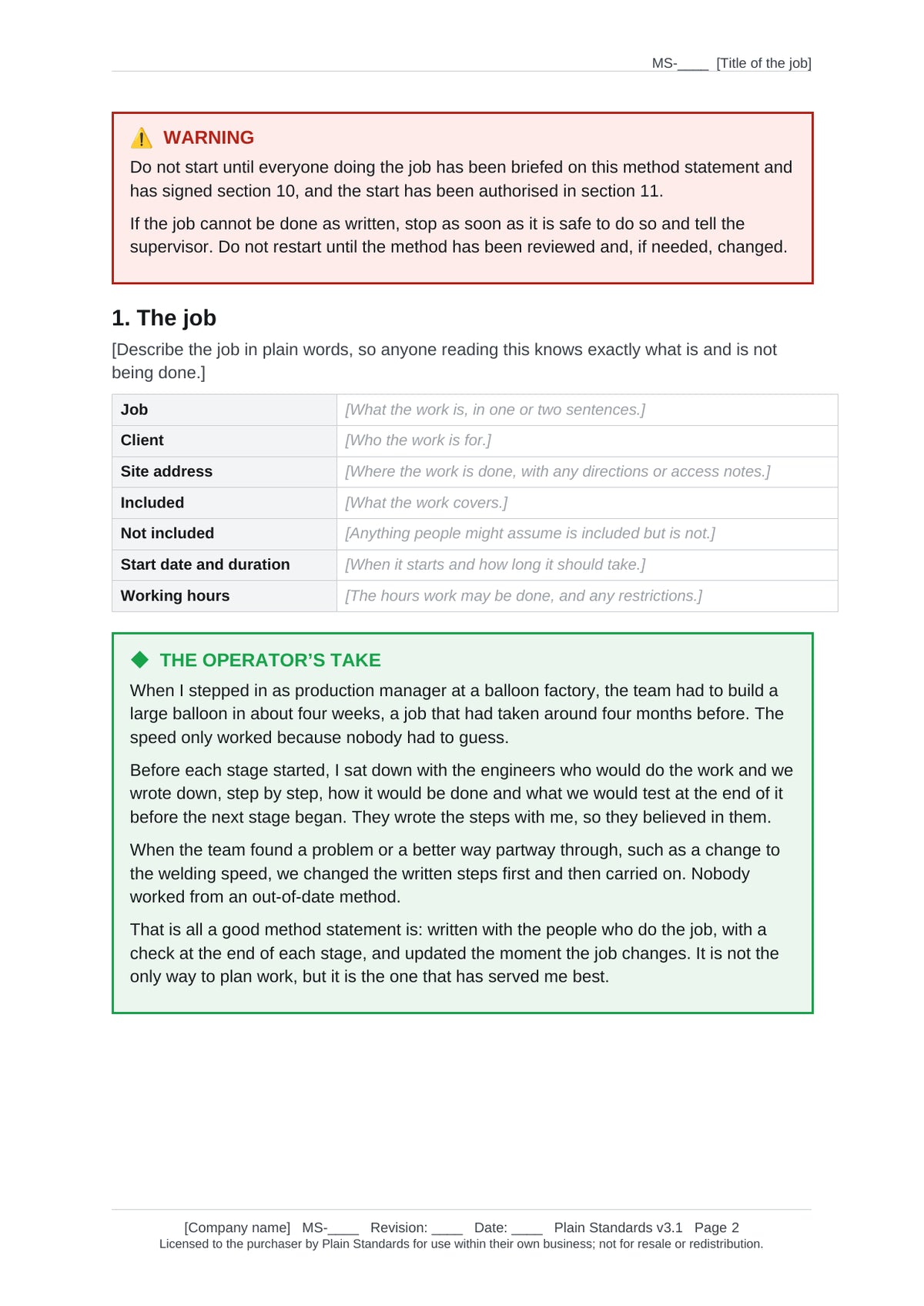
When I stepped in as production manager at a balloon factory, the team had to build a large balloon in about four weeks, a job that had taken around four months before. Before each stage, the engineers who would do the work and I wrote down every step and the test at the end of it, and when we found a better way, we changed the written steps first. This template is built the same way.

Who this is for

Any business that needs to plan a job safely and show the plan to a client, a main contractor or an inspector. In the UK and Ireland it is called a method statement; in Australia, a SWMS; in the US, the same idea usually goes by a work plan, and for a single task many US firms use a job hazard analysis instead, which is our Job Safety Analysis Template. You don't need a safety consultant to use it.

It is a template to fill in, not legal advice, and it does not come with your job already written, because nobody knows your job like the people who do it. Do the risk assessment first; the method statement shows how the job will be done with those controls in place.

See an example

The worked example inside the template follows a small contractor replacing 40 metres of gutter on a two-storey office building from a mobile elevating work platform (US: aerial lift). Here it is in brief:

  • Before work starts: the car park below is fenced off, staff use the rear entrance, and the ground is checked firm and level for the platform.
  • Hazards and controls: work only from the platform with a harness clipped to its anchor point; an exclusion zone below and tools tied on; outriggers on pads and the wind checked against the maker's limit; clearance from the nearby power line agreed with its owner before work.
  • Steps, each with its check: set up barriers (zone clear?), set up and test the platform (pre-use check signed?), take down the old gutter (nothing left loose?), fit the new gutter (falls to the outlet?), water test (no leaks?), clear the site (barriers removed last?).
  • Australia: a possible fall of more than 2 metres and moving powered plant make it high risk construction work, so the method statement is its SWMS.
  • Briefing: all three workers sign before the barriers go up.

The template walks you through the same plan for your own job, section by section.

It is built for any business that does practical work at a client's site or its own: builders and trades, roofers, electricians, plumbers, scaffolders, groundworkers, cleaning and maintenance contractors, installers, engineering and fabrication firms, and facilities teams. The jobs differ; the way you plan one safely does not.

This is a ready-made method statement template in Microsoft Word. It sets out one job from start to finish: what the job is and is not, the people and their training, the checks before work starts, the hazards and controls from your risk assessment, the plant and equipment, the protective equipment, the sequence of work with a check before each next step, and the emergency arrangements.

Then it makes the plan stick: a log for checking the work is being done as written, a record of changes, a briefing record everyone signs, and an authority to start. A short Start here page and a worked example show you how to fill it in. One $29 payment covers your whole business, every job and every site, as often as you need.

Written with the people who do the job

The template tells you to write the method with the crew who will do the work. They know the job best, they spot the steps an office would miss, and people follow steps they helped write.

A check before every next step

Every step in the sequence of work has a check that must be passed before the next one starts. Problems are caught at the stage they happen, not at handover, when putting them right costs the most.

RAMS in two documents that fit together

Do the risk assessment first with our Risk Assessment Template: it finds what could hurt someone and decides the controls. The method statement then shows how the job will be done with those controls in place. Together they are the RAMS many clients and main contractors ask for.

Ready for a SWMS in Australia

Safe Work Australia says a SWMS must name the high risk construction work, its hazards and risks, the controls, and how they will be put in place, monitored and reviewed. This template has a place for every one of those, plus a tick list of the 18 kinds of high risk construction work. Check your state or territory regulator's own requirements before you rely on it.

Briefed, signed and authorised before anyone starts

A briefing record that every worker signs, and an authority to start signed by the person in charge, so you can show who knew the plan and who approved the start. If the work cannot be done as written, the method says stop, review and brief again.

Where this leads

Why buy from us

  • ✓Built by a company director, not an auditor. Written by someone who ran real businesses before building management systems, so what you get works in the real world, not just on paper.
  • ✓Written in plain English. No jargon, no clause-speak. If you are new to ISO 9001, it will make sense on day one.
  • ✓The Operator's Take, in every document. Look inside any Plain Standards document and you will find a boxed note called The Operator's Take: a short, plain comment from someone who has run businesses, explaining why this document actually matters to yours, and how to get real value from it, not just tick a box for an auditor. No other provider gives you this, because it comes from having sat in the chair.

What should a method statement include?

The job and what it does and does not include, the people and their training, the checks before work starts, the hazards and controls from the risk assessment, the plant and equipment, the protective equipment, the steps in order with their checks, the emergency arrangements, and a record that everyone was briefed. This template has a section for each.

What is the difference between a risk assessment and a method statement?

A risk assessment finds what could hurt someone and decides the controls. A method statement sets out, step by step, how the job will be done with those controls in place. Do the risk assessment first; together they are often called RAMS.

Is a method statement a legal requirement?

It depends where you work. In the UK, the HSE says method statements are not required by law except for demolition or dismantling, where the arrangements must be written down before work begins, though a risk assessment is always required. In Australia, a SWMS is required before high risk construction work starts. In the US, no federal OSHA rule calls for a document named a method statement, but clients and general contractors often ask for a written work plan.

Can I use this as a safe work method statement (SWMS)?

Yes. It has a place for everything Safe Work Australia lists for a SWMS: the high risk construction work, its hazards and risks, the controls, and how they will be put in place, monitored and reviewed. It also includes a tick list of the 18 kinds of high risk construction work. Check your state or territory regulator's own requirements before you rely on it.

Is it a Word file?

Yes, it is a Microsoft Word file (.docx), so you can type straight into it, copy it for each job and print it for site. It also opens in Google Docs and other word processors that read .docx files.

Written by Mike Armstrong, senior ISO consultant, former company director, and founder of Plain Standards. In over 30 years running companies at director level, Mike built his own management systems to drive profit long before he adopted ISO 9001, so he comes at this from the owner's side, not the auditor's. Plain Standards helps small and medium sized businesses get ISO certified.

  • 5 stars: 1 (100%)
  • 4 stars: 0 (0%)
  • 3 stars: 0 (0%)
  • 2 stars: 0 (0%)
  • 1 star: 0 (0%)
A
Abigail Cross

Great template. Staff feedback very positive with easy to follow steps