Risk Assessment Template (Word)
A ready-written document you adapt to your business. Instant download.
Find what could harm your people before it costs you a worker, a claim or a contract.
Used properly, this is what it does for your business:
- ✓More customers: show customers and main contractors a current, signed risk assessment when they ask for one.
- ✓More profit: fewer accidents, fewer days lost and fewer costly claims.
- ✓Less stress: peace of mind that you've found the hazards and dealt with them, instead of hoping nothing goes wrong.
- ✓Look the part: a written record ready for any inspector, insurer or customer who asks how you keep people safe.
Why not a free risk assessment template? Many give you a blank grid and leave the rest to you. This one brings together what OSHA in the US, the HSE in the UK and ISO 45001 each recommend, in one document: a common hazards list, a simple Low, Medium and High rating, controls chosen strongest first, an on-the-day check, a worked example and sign-off. It was written by a company director of over 30 years who has carried out risk assessments across a wide range of industries.
"Plain Standards have continually under-promised and over-delivered. Outstanding service." Paul J, ATM Security

A wet floor at the door, a heavy box lifted the wrong way, a forklift reversing where people walk. Accidents like these often start with a hazard someone could have spotted, and the cost lands on the business: days lost, a claim against you, or a customer who stops sending work. Customers and main contractors can also ask to see your risk assessments before they award you a job. And in the US, OSHA requires a written certification of your hazard assessment wherever workers need protective equipment; in the UK, if you employ five or more people, the law requires you to write down the significant findings of your risk assessment.
In over 30 years running companies at director level, including a care company with carers in clients' homes every day, I learned that a risk assessment is only right on the day it is written. This template is the way I would run one in any business: walk round with the people who do the work, rate each risk simply, choose the strongest fix first, and give everyone a quick way to spot what has changed before each job.
Who this is for
Any business with people at work, in any industry. It suits a business with no health and safety specialist, and you don't need any experience of risk assessment to use it.
It is a general workplace risk assessment. Some hazards have their own detailed rules and their own assessments, such as fire, hazardous chemicals or asbestos. Use this template for your general assessment and alongside those, not instead of them.
See an example
The worked example inside the template follows a small joinery firm in England assessing how its joiners lift heavy doors, after two back strains in January and March. Here it is in brief:
- Who could be harmed: the joiners at door assembly, and anyone who helps them lift.
- Lifting doors by hand: back strain. Likely and moderate, so rated High, because the two-person rule was skipped. Done the same day: no heavy door is lifted until two people are free. Lasting fix: a vacuum lifter chosen with the joiners, and a written work instruction. Rated Low afterwards.
- A door slipping from the lifter: crushed feet or hands. Possible and major, so rated High. Fix: nobody stands beside a lifted door, and the vacuum gauge is checked before every lift. Rated Medium afterwards and kept under review.
- A chance to make the work safer: the joiners suggested a turning table, so a door can be turned without lifting it at all.
- On-the-day check: a door slipped because the lifter pad had not been cleaned. The lift was stopped, and the pad is now cleaned before every lift.
The template walks you through the same assessment for any job, section by section.
It is built for any business that has people at work, whatever you make or do: builders and trades, event organisers, schools and nurseries, cafés, restaurants and food businesses, offices, care providers, warehouses and delivery firms, factories and workshops, shops, hotels, farms, cleaning and maintenance firms, and charities. The hazards differ from one trade to the next; the way you find them and fix them does not.
This is a ready-made risk assessment template in Microsoft Word. It gives you everything you need to find the hazards in a job, task or area, decide who could be harmed and how, rate each risk, choose controls in the right order, and keep the assessment up to date.
It is laid out in the order you use it: what is being assessed; who could be harmed, including people at higher risk such as new or expectant mothers, young workers and people working alone; the hazards and controls table, recording how likely and how serious each risk is and its rating, before and after, with a place for chances to make the work safer or healthier; an on-the-day check for anything that has changed since the assessment was written; review dates; a record of who has been shown it; and sign-off.
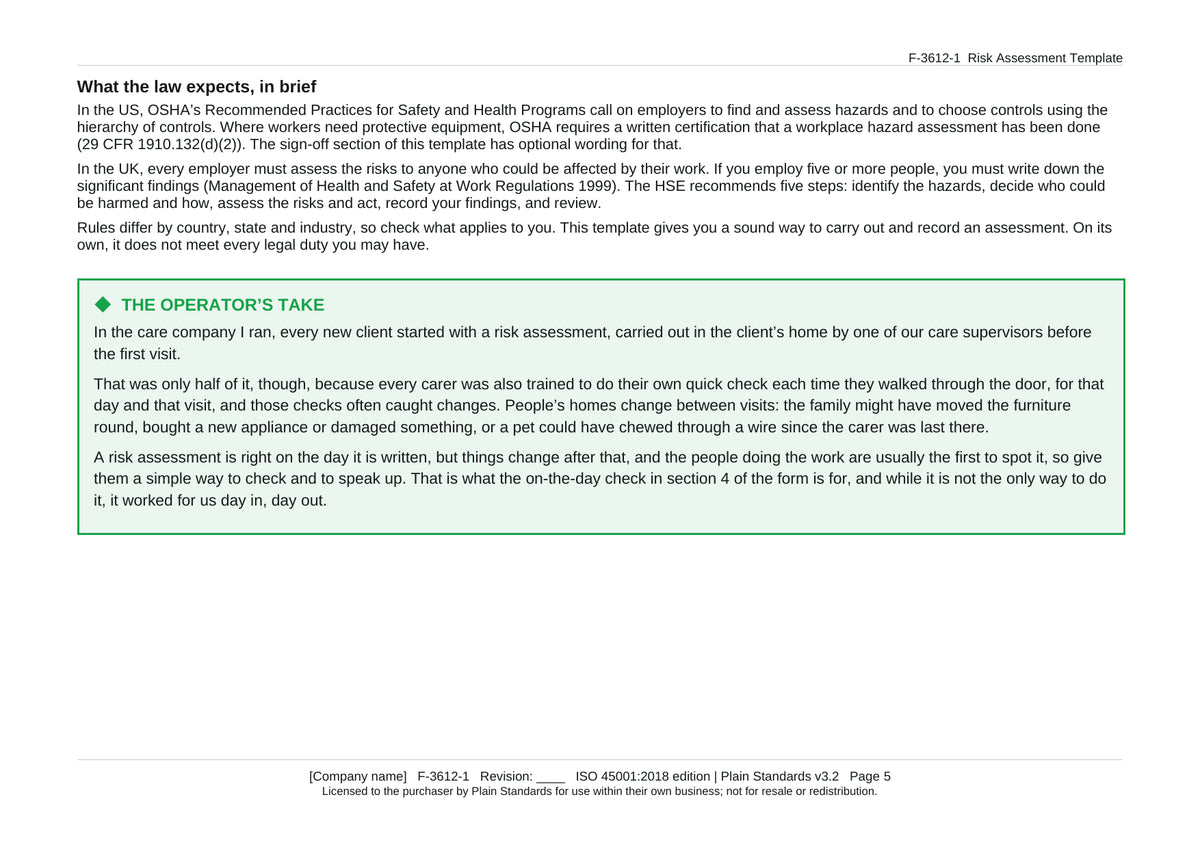
Before the blank form, short guidance pages explain how to rate a risk with a simple Low, Medium and High grid, how to choose controls best first, the common hazards to look for, what the law expects in the US and the UK, and the key words in plain English. A worked example shows a full assessment you can copy. Use a fresh copy for each job, task or area: one $29 payment covers every job, task and area you assess in your business, as often as you need.
The steps the regulators recommend, in the order you need them
The steps differ slightly between the US and the UK, and the template follows both. Wherever you are, it follows the approach set out in ISO 45001, the international standard for health and safety management; check your own country's rules for anything extra you must record. In the US, it follows OSHA's recommended approach to finding and fixing hazards: use what you already know, involve your workers, walk the workplace, cover non-routine work and emergencies, and fix the biggest risks first. In the UK, it follows the five steps the Health and Safety Executive (HSE) recommends: find the hazards, decide who could be harmed and how, assess the risks and act, record what you found, and review it.
A risk rating anyone can use
How likely, against how serious. Read off Low, Medium or High where they meet, and the template tells you what each means: act now, bring it down with a name and a date, or keep the controls you have. No scoring sums to get wrong.
The strongest fix first
Controls are chosen in order: remove the hazard, swap it for something safer, guard it or keep people away from it, then rules and training, and protective equipment last. That is the order OSHA uses in the US and ISO 45001 sets out, because the fixes at the top protect everyone without relying on people remembering.
A quick check before every job
A risk assessment is right on the day it is written. Then the furniture gets moved, a guard gets taken off, a new starter arrives. The on-the-day check gives the people doing the work a simple way to spot what has changed, make it safe and tell someone, with a log so you can see it happening.
Never start from a blank page
A one-page list of common hazards, from slips and trips to lone working, stress and heat, prompts you to look in the places that are easy to miss.
Proof it was done and shared
Space to record who was shown the assessment and signed it, when it was reviewed and why, and who approved it. For US employers whose workers need protective equipment, the sign-off includes optional wording for the written certification of hazard assessment that OSHA requires.
Ready if you build a health and safety management system
ISO 45001, the international standard for health and safety management systems, requires a business to keep identifying hazards, assess the risks taking account of the controls already in place, keep written information on how it assesses risk, involve the people who do the work, and choose controls in a set order (clauses 5.4, 6.1.2 and 8.1.2). This template covers each of those. You don't need ISO 45001 to get value from it today.
Where this leads
- Job Safety Analysis Template: for a risky job, break it into steps and make each step safe before work starts.
- Method Statement Template: for a bigger job, write the steps, who does what and the checks, ready for your client before you start.
- Incident Report Template: when something does go wrong, record it, find the cause and fix it for good.
- Risk Register Template: list the risks to the business itself, such as losing a key customer or supplier.
- What is ISO 45001: the health and safety management system standard in plain English.
- ISO 45001 Audit Checklist Template: find the gaps in your health and safety system yourself, before an accident, an inspector or a customer's auditor finds them for you.
- Business Templates: every ready-made template for running a business well.
Why buy from us
- ✓Built by a company director, not an auditor. Written by someone who ran real businesses before building management systems, so what you get works in the real world, not just on paper.
- ✓Written in plain English. No jargon, no clause-speak. If you are new to ISO 9001, it will make sense on day one.
- ✓The Operator's Take, in every document. Look inside any Plain Standards document and you will find a boxed note called The Operator's Take: a short, plain comment from someone who has run businesses, explaining why this document actually matters to yours, and how to get real value from it, not just tick a box for an auditor. No other provider gives you this, because it comes from having sat in the chair.
Is this risk assessment template in Word?
Yes, it is a Microsoft Word file (.docx) that you download straight away and edit like any other Word document. It also opens in Google Docs and other word processors that read .docx files, though a few layout details may shift slightly outside Word.
Is there an Excel version?
No, it is a Word document. A risk assessment is mostly written answers, notes on who could be harmed and signatures, which suit Word better than a spreadsheet. If you want to track many assessments, list each one's reference, area and review date in a simple spreadsheet.
Does it include a risk matrix?
Yes. It uses a simple three by three grid: how likely (unlikely, possible, likely) against how serious (minor, moderate, major), giving a Low, Medium or High rating and what to do about each. It is a guide to how fast to act, not a precise score. Each level of how likely is defined in plain words, so two people rating the same job get the same answer.
How often should a risk assessment be reviewed?
Whenever something changes: straight away after an accident or near miss, when work, equipment, people or premises change, or when someone raises a concern. OSHA recommends regular inspections to catch new hazards, and the UK HSE says to review your controls when things change and update the record. We also suggest a review at least once a year, and the template has a review log for it.
What is a dynamic risk assessment?
It usually means a quick check made on the spot, just before or during a job, for anything that has changed since the written assessment. The template includes one, called the on-the-day check, with a log to record what was found and what was done.
Is a risk assessment a legal requirement?
In the US, OSHA requires employers to assess the workplace for hazards that call for protective equipment and to certify that assessment in writing. In the UK, yes: every employer must assess the risks to anyone affected by their work, and if you employ five or more people you must write down the significant findings. Rules differ by country, state and industry, so check what applies to you. This template gives you a sound way to carry out and record the assessment.
Who should carry out a risk assessment?
The employer is responsible for it, and can do it themselves or bring in a competent person to help, as the UK HSE puts it. Either way, involve the people who do the work: OSHA recommends putting workers on the inspection team, because they often know what goes wrong better than anyone.
Is there a free risk assessment template?
Yes, there are many online, including a free basic template from the UK HSE. This one adds a common hazards list, a simple risk rating, controls chosen best first, an on-the-day check, a worked example and sign-off, so it is ready to use without working out the rest yourself.
Written by Mike Armstrong, senior ISO consultant, former company director, and founder of Plain Standards. In over 30 years running companies at director level, Mike built his own management systems to drive profit long before he adopted ISO 9001, so he comes at this from the owner's side, not the auditor's. Plain Standards helps small and medium sized businesses get ISO certified.
- 5 stars: 1 (100%)
- 4 stars: 0 (0%)
- 3 stars: 0 (0%)
- 2 stars: 0 (0%)
- 1 star: 0 (0%)
Great for a small business with no health and safety specialist.