Root Cause Analysis Template and Corrective Action Plan (Word)
A ready-written document you adapt to your business. Instant download.
The same mistake keeps coming back because nobody fixed the cause. This root cause analysis template finds it, step by step.
Used properly, this is what it does for your business:
- ✓More customers: complaints are dealt with at the cause, so customers see you take them seriously and stay.
- ✓More profit: less money lost to repeat mistakes, refunds and work done twice.
- ✓Less stress: fewer fires to fight, because far fewer of the same ones start again.
- ✓Look the part: a clear written record of what went wrong and what you did about it, for any customer, insurer or assessor who asks.
Why not a free root cause analysis template? Many are a blank fishbone diagram or a list of five boxes, with nothing to stop you blaming a person, no action owners and no check the fix worked. This one takes you all the way from the problem to a fix that holds, written by a former company director who has investigated problems for over 30 years.
"Plain Standards have continually under-promised and over-delivered. Outstanding service." Paul J, ATM Security
Most businesses deal with a problem by fixing what is in front of them: refund the customer, redo the job, have a word with whoever was on shift. Then, a few weeks later, it happens again. Each time costs money, time and a little more of the customer's patience.
As a production manager on a factory floor, and later running my own companies, I learned that people will not tell you what really happened if they are worried about the reaction. So in over 30 years running businesses, the investigations that worked all followed the same method: look at the process, not the person, keep investigating until you reach something you can change, and check the fix worked. This template is that method, laid out so anyone in your business can follow it.
Who this is for
Any business where the same problems keep coming back: a late delivery, a wrong order, a customer complaint, a near miss, a job that had to be done twice. It suits an online shop, a dental practice, a care provider, a workshop, a building firm or an office. If a customer has asked what you are doing to stop it happening again, this gives you the answer in writing. You do not need any experience of root cause analysis, and you do not need to be working towards a certificate.

This is a ready-made root cause analysis template in Microsoft Word. It takes you through one problem from start to finish: what went wrong, what you did straight away, why it really happened, what you will change, and whether the change worked.
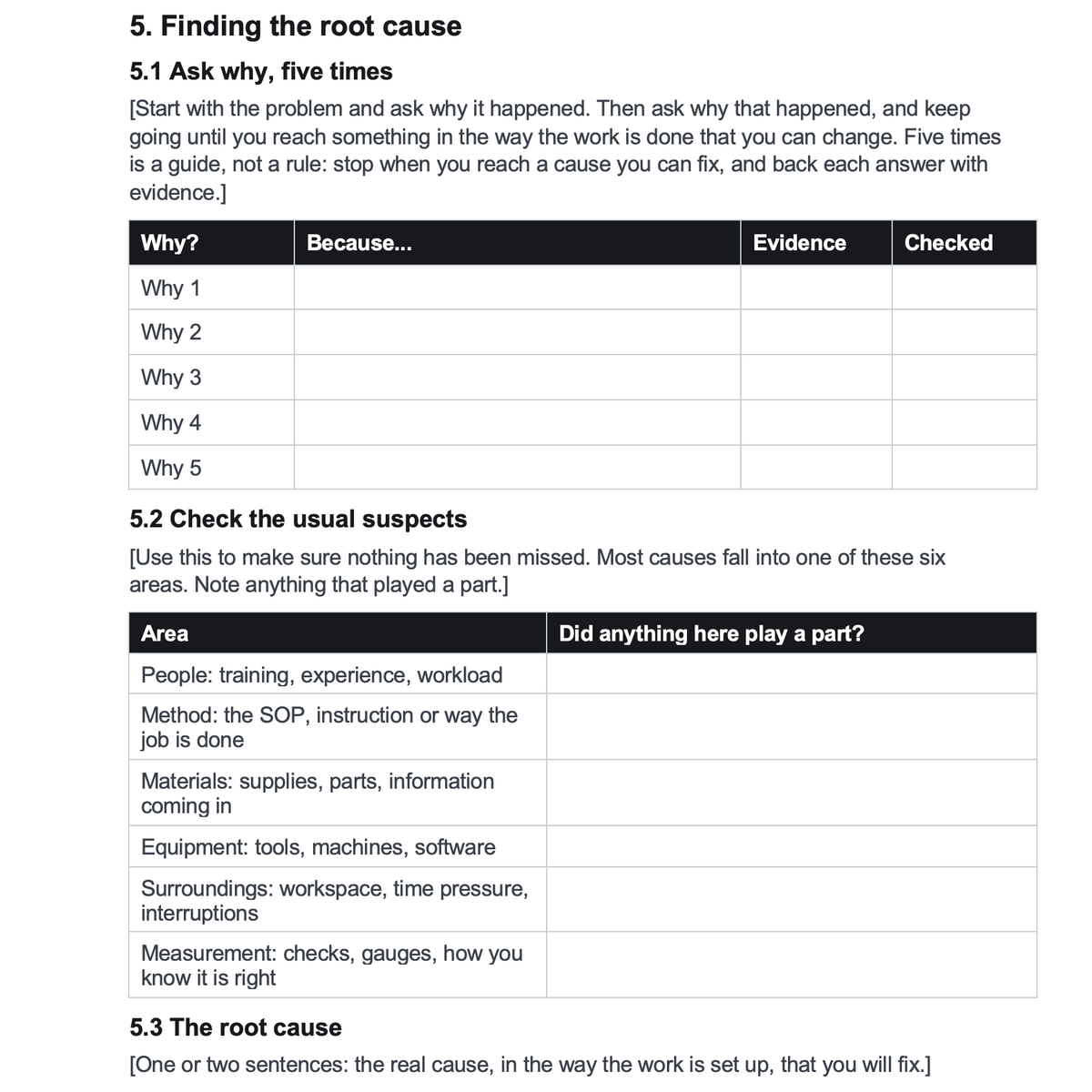
It covers every part a proper investigation needs: a cover with reference number, sign-off by the investigator, reviewer and the person who closes it; record details; what happened; the immediate action; who is investigating; the facts and evidence; a five whys table with an evidence column; a six-area check of the usual causes (people, method, materials, equipment, surroundings, measurement); the root cause; a corrective action plan with an owner, due date and done date for every action; a check that it worked; what to share and update; and the key words explained.
It also comes with a removable Start here page, a short note on running an investigation people will be open with, and a worked example you can copy: online orders sent to customers' old addresses, traced to a missing step in the dispatch procedure. One template, as many investigations as you need: make a fresh copy for each problem.
Fix the cause, not the symptom
Refunding the customer and redoing the job deals with today. It does nothing about next month. This template takes you past the obvious answer to the real cause, the gap in the way the work is set up, so the fix you make is far less likely to need making again.
Five whys and a fishbone check, without the jargon
The five whys table walks you from the problem to the cause one question at a time, with a column for the evidence behind each answer, so the cause you write down is fact, not opinion. Then a simple six-area check, based on the fishbone method, makes sure nothing has been missed. No diagrams to draw and no training needed.
Built so people tell you the truth
An investigation that hunts for someone to blame gets half the story. The note inside the template shows how to run it so people are open with you: say at the start it is not a witch hunt, explain that you are looking for what in the process let the mistake happen, and talk to the people who do the job every day. They usually know the cause before anyone else does.
A corrective action plan that gets done
Most investigations stall at "we must do better". Here every action has one owner, a due date and a done date, and the investigation is not closed until you have checked the fix actually worked. If the problem comes back, the template tells you to reopen it and look again.
A worked example to copy
Inside you will find a finished example: three orders in one month sent to customers' old addresses. It shows the immediate action, four whys leading to a missing step in the dispatch procedure, the corrective actions with owners, and the check one week later. Copy the pattern for your own problem, then delete the example.
Ready if you ever go for certification
In ISO 9001, this is what corrective action means (clause 10.2), and the template carries the sign-off and record an assessor expects to see. If you already have a corrective action form, record the summary on it and keep this investigation with it as the evidence. You do not need any of that to get value from it today.
Where this leads
- How to do a root cause analysis: the free step-by-step guide, with two real examples and a free worksheet.
- Corrective action vs preventive action: the difference, with examples, and how to carry out each one.
- SOP Template: when the fix is a missing or unclear step, write it into a standard operating procedure.
- The ISO 9001:2026 Certification-Ready System: the complete system, including the corrective action procedure, form and register.
Why buy from us
- ✓Built by a company director, not an auditor. Written by someone who ran real businesses before building management systems, so what you get works in the real world, not just on paper.
- ✓Written in plain English. No jargon, no clause-speak. If you are new to ISO 9001, it will make sense on day one.
- ✓The Operator's Take, in every document. Look inside any Plain Standards document and you will find a boxed note called The Operator's Take: a short, plain comment from someone who has run businesses, explaining why this document actually matters to yours, and how to get real value from it, not just tick a box for an auditor. No other provider gives you this, because it comes from having sat in the chair.
What is a root cause analysis template?
A root cause analysis template is a ready-made layout for investigating a problem: it takes you from what went wrong, through why it really happened, to what you will change and how you will check the change worked. Instead of starting from a blank page, you fill in your own problem under headings already in the right order.
Does this template use the five whys?
Yes, it includes a five whys table with a column for the evidence behind each answer and a column to tick it off. The template treats five as a guide, not a rule: you stop when you reach a cause in the way the work is done that you can change.
Does it include a fishbone diagram?
It includes the six cause areas of the fishbone, or Ishikawa, method as a simple checklist table: people, method, materials, equipment, surroundings and measurement. You get the same check without having to draw a diagram.
Does it include a corrective action plan?
Yes, the corrective action plan is built in. Every action gets one owner, a due date and a done date, and there is a section to record how and when you checked the action worked. If the problem comes back, you reopen the investigation.
Is this root cause analysis template in Word?
Yes, it is a Microsoft Word file (.docx) that you download instantly and edit like any other Word document. It also opens and edits in Google Docs and other word processors that read .docx files, though a few layout details may shift slightly outside Word.
Is there an Excel or PowerPoint version?
No, it is a Word document, because an investigation is a written record you fill in, sign off and keep. If you need to present the findings, copy the root cause and the action plan into your slides.
Can I use it for complaints, incidents and near misses?
Yes, it works for any problem in any business: a customer complaint, a repeat mistake, a near miss or a missed deadline. If a regulator or insurer requires its own report format for an accident, use that as well and keep this investigation with it.
Is there a free root cause analysis template?
Yes, there are free ones online, and some are fine for a quick check. Many, though, are a blank diagram or five empty boxes, with no evidence column, no action owners and no check that the fix worked. This template includes all of those, a worked example, and a note on running an investigation people will be open with.
Can I use this template for ISO 9001 corrective action?
Yes, ISO 9001 calls this corrective action (clause 10.2), and the template covers what the standard asks for: react to the problem, find the cause, act on it, check the action worked and update your system. It is written for any business, so you do not need to be working towards certification to use it.
Written by Mike Armstrong, senior ISO consultant, former company director, and founder of Plain Standards. In over 30 years running companies at director level, Mike built his own management systems to drive profit long before he adopted ISO 9001, so he comes at this from the owner's side, not the auditor's. Plain Standards helps small and medium sized businesses get ISO certified without a consultant.
- 5 stars: 1 (100%)
- 4 stars: 0 (0%)
- 3 stars: 0 (0%)
- 2 stars: 0 (0%)
- 1 star: 0 (0%)
corrective actions is something that's confused me for a long time. This, however, helped me to understand it completely - thank you!